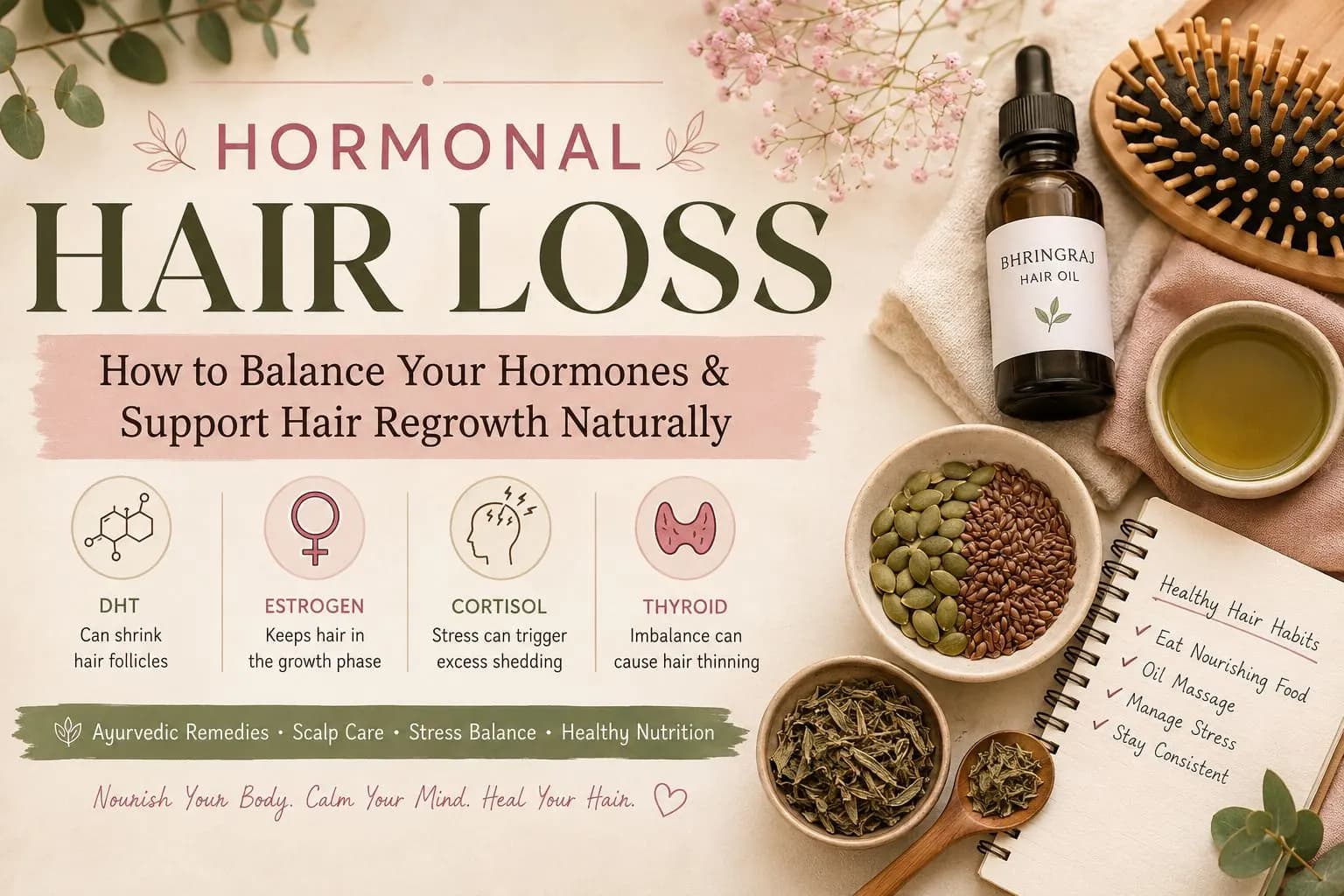
Hormonal Hair Loss: How to Balance Your Hormones & Support Hair Regrowth Naturally
Have you noticed more hair than usual on your pillow, in your hairbrush, or during your shower? Or perhaps your center part seems wider and your ponytail feels thinner?
Sometimes, the problem isn't your shampoo or hair-care routine. Hormonal changes can play an important role in hair shedding and thinning.
Hormonal fluctuations can happen during pregnancy and postpartum recovery, periods of prolonged stress, changes in birth-control use, menopause, PCOS, or thyroid disorders. These changes can affect the normal hair-growth cycle and may lead to increased shedding or gradual thinning.
Ayurvedic hair care has traditionally focused on maintaining a healthy scalp, nourishing the body, reducing stress, and supporting overall balance.
The goal isn't to find one magical remedy. Instead, think of hormonal hair care as a combination of nutrition, scalp care, stress management, gentle hair practices, and addressing underlying causes when necessary.
1. How Hormones Can Affect Hair Growth
Your hair doesn't grow continuously. Each follicle moves through different stages of the hair-growth cycle.
Hormonal changes can interfere with this cycle and cause more hairs to enter the resting or shedding phase.
DHT and Hair Follicles
Dihydrotestosterone, or DHT, is an androgen hormone produced from testosterone.
In people who are genetically sensitive to DHT, prolonged exposure can cause certain scalp follicles to gradually become smaller. This can result in finer strands and progressive thinning, particularly around the crown or hairline.
This type of hair loss is commonly associated with androgenetic alopecia.
Estrogen and Hair Shedding
Estrogen can influence the hair-growth cycle.
During pregnancy, higher estrogen levels can keep more hairs in the growth phase, which is one reason some women notice thicker-looking hair.
After delivery, hormone levels change rapidly. A larger number of hairs may then enter the resting phase, resulting in postpartum shedding, also known as telogen effluvium.
The shedding can look dramatic, but many women gradually regain their normal hair density as the growth cycle recovers.
Cortisol and Stress
Long-term physical or emotional stress can affect the hair-growth cycle.
Stress-related shedding often doesn't happen immediately. Increased hair fall may become noticeable several weeks or months after a significant stressor.
This is why stress management is an important part of a healthy hair routine.
Thyroid Hormones
Thyroid hormones influence many processes throughout the body, including metabolism and tissue growth.
Both an underactive and overactive thyroid can sometimes be associated with diffuse hair thinning or increased shedding.
If hair loss is sudden, excessive, or accompanied by other symptoms, it's worth discussing it with a healthcare professional rather than relying only on topical remedies.
2. Ayurvedic-Inspired Ways to Support Hair Health
Ayurveda places strong emphasis on nourishing the body and caring for the scalp.
These practices can be incorporated into a gentle hair-care routine, but they shouldn't replace medical evaluation when hormonal or medical hair loss is suspected.
A. Nourish Your Hair From Within
Healthy hair requires adequate nutrition.
Instead of focusing on one "hair growth food," aim for a balanced diet containing:
Protein-rich foods
Iron-rich foods
Zinc
Omega-3 fats
Vitamin-rich fruits and vegetables
Whole grains
Nuts and seeds
Simple Daily Seed Routine
Flax seeds, pumpkin seeds, chia seeds, and sesame seeds can be nutritious additions to a balanced diet.
Try adding 1–2 tablespoons of ground or properly chewed seeds to foods such as:
Oatmeal
Smoothies
Yogurt
Salads
Chilla
Homemade energy bites
There is interest in seed cycling for hormonal health, but strong clinical evidence that seed cycling itself treats hair loss is currently limited. Think of seeds as nutrient-rich foods, rather than a guaranteed hormone-balancing treatment.
3. Try a Gentle Scalp Oil Massage
Scalp massage can be a relaxing addition to your routine.
Traditional Ayurvedic hair care commonly uses oils such as:
Coconut oil
Sesame oil
Bhringraj oil
Brahmi-infused oil
Amla-infused oil
You don't need to use a large amount of oil.
Simple Shiro Abhyanga-Inspired Routine
Take a small amount of suitable hair oil.
Warm it slightly if comfortable.
Apply it gently to the scalp.
Use your fingertips rather than your nails.
Massage gently for about 5–10 minutes.
Leave the oil on for a period that suits your scalp and hair.
Wash with a gentle shampoo.
The main benefit may be relaxation and scalp care. Avoid vigorous rubbing, especially if your scalp is irritated or sensitive.
4. Rosemary for Hair Care
Rosemary has become popular in natural hair-care routines because some research has explored its potential role in hair growth.
If you want to use rosemary essential oil, never apply it directly to the scalp undiluted.
Always dilute essential oils in a suitable carrier oil and perform a patch test first.
If you experience burning, itching, redness, or irritation, stop using it.
Natural does not automatically mean risk-free, so gentle application matters.
5. Manage Stress for Healthier Hair
You can't completely eliminate stress from everyday life.
But creating small periods of relaxation may support your overall wellbeing and make your hair-care routine easier to maintain.
Try one of these simple habits:
Take slow, deep breaths.
Stretch your neck and shoulders.
Practice a few gentle yoga movements.
Take a short walk.
Put your phone away for a few minutes.
Massage your scalp gently.
Go to bed at a consistent time.
5-Minute Evening Reset
You don't need a complicated wellness routine.
Five consistent minutes can be better than an elaborate routine you never follow.
6. A Simple Daily Hormonal Hair-Care Routine
TimePracticePurposeMorningProtein-rich breakfast + seedsSupports overall nutritionAfternoonStay hydrated + balanced mealSupports general wellbeingEvening5–10 minutes relaxationHelps manage daily stressHair-wash daysGentle scalp cleansingKeeps scalp clean2–3 times weeklyGentle scalp massageRelaxation + scalp careDailyAvoid tight hairstylesReduces mechanical stress
7. What You Should Avoid
When you're experiencing hair shedding, it's tempting to try every hair-growth hack you see online.
Instead, simplify your routine.
Try to avoid:
Very tight ponytails and buns
Frequent high-heat styling
Aggressive brushing
Scratching the scalp
Leaving heavy buildup on the scalp
Excessive chemical treatments
Crash diets
Taking high-dose supplements without medical advice
Your hair doesn't need a complicated routine.
It needs consistency and gentle care.
8. When Hormonal Hair Loss Needs Medical Attention
Natural hair care can support your routine, but it cannot correct every underlying cause of hair loss.
Consider speaking with a dermatologist or healthcare professional if you notice:
Sudden or severe hair shedding
Rapidly widening parting
Bald patches
Persistent scalp itching or inflammation
Hair loss continuing for several months
Hair loss after starting a medication
Significant menstrual changes along with hair thinning
Unexplained fatigue or other symptoms
Signs that may suggest thyroid or nutritional problems
Depending on your symptoms and medical history, a healthcare professional may recommend appropriate examination or blood tests.
Finding the underlying cause is often more important than simply treating the hair that has already fallen.
9. The 90-Day Hair Growth Mindset
One of the biggest mistakes people make is expecting visible hair growth within a few weeks.
Hair grows slowly, and changes in the hair-growth cycle take time to become visible.
Instead of checking your hair every day, track your progress over several months.
Take photographs:
From the front
From both sides
From the back
Of your center part
Under similar lighting each time
Also track improvements such as:
Less daily shedding
Fewer broken hairs
Better scalp comfort
Stronger-looking strands
Improved hair texture
Better consistency with your routine
Remember: healthy hair progress isn't measured only by length.
Final Thoughts
Hormonal hair loss can feel frustrating, especially when you're doing everything you can to take care of your hair.
But your hair doesn't exist separately from the rest of your body.
Nutrition, hormones, stress, sleep, scalp health, genetics, medications, and overall health can all influence the hair-growth cycle.
A gentle routine combining balanced nutrition, scalp care, stress management, and consistent hair habits can support healthier hair.
And if your hair loss seems unusual or persistent, don't simply keep adding more oils and supplements. Find out what's happening underneath.
Your goal isn't overnight regrowth.
Your goal is to create the healthiest environment possible for your hair to grow and thrive. 🌿
A Gentle Reminder
There is no single oil, seed, herb, or supplement that can guarantee hormonal hair regrowth.
Natural remedies can complement a healthy routine, but persistent or significant hair loss deserves proper evaluation.
Be patient. Be consistent. Take care of your scalp—and give your hair time. ❤️